
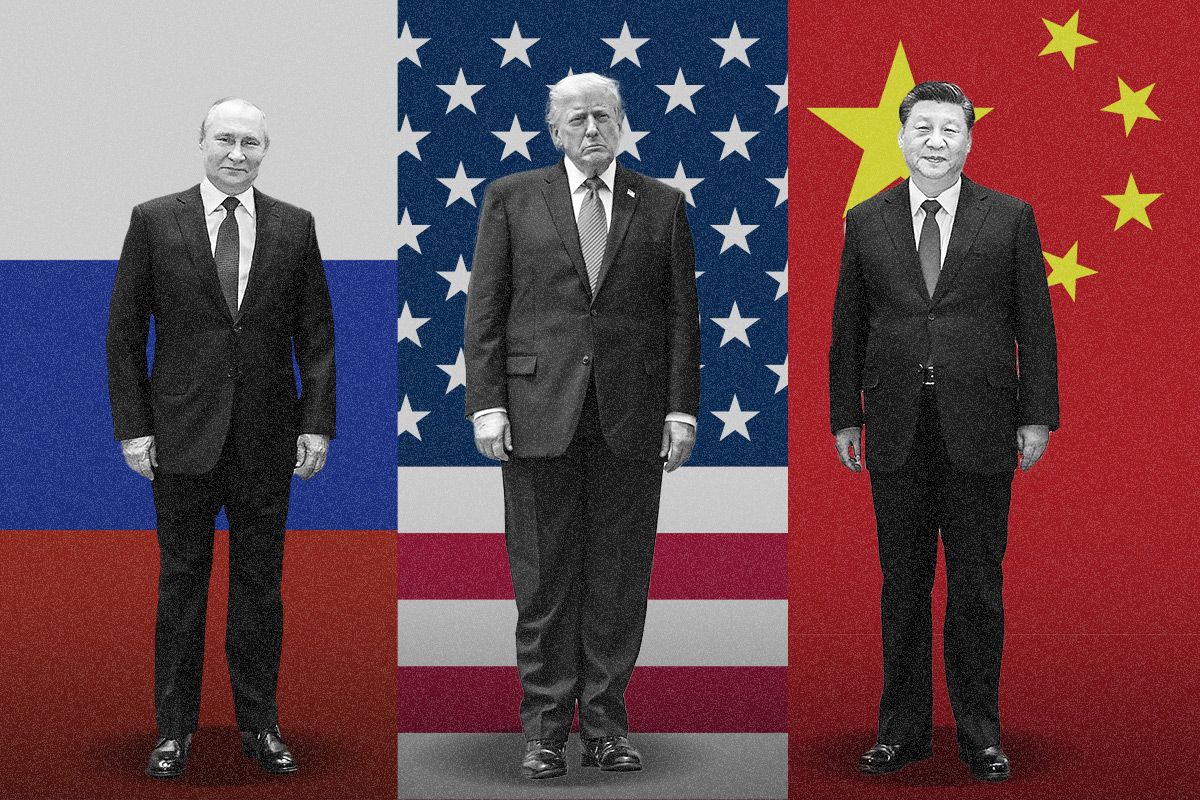
U.S. President Donald Trump, Russian President Vladimir Putin and Chinese President Xi Jinping held their first trilateral meeting in Shenzhen, China, on Nov. 19, 2026, prompting concern among U.S. allies about the future of international security and diplomacy. (Foto: Instagram)
The first trilateral meeting of U.S. President Donald Trump, Russian President Vladimir Putin and Chinese President Xi Jinping has raised concern among Washington’s long-standing allies. Held in Shenzhen, China, on Thursday, Nov. 19, 2026, the gathering featured mutual praise and pledges of cooperation, renewing questions about U.S. foreign policy and alliances that have underpinned international security since World War II.
The meeting took place on the sidelines of the Asia-Pacific Economic Cooperation summit and brought together the leaders of the world’s three largest nuclear powers in a trilateral format for the first time. Trump’s willingness to negotiate directly with Putin and Xi, without European or Asian partners at the table, heightened concerns that major powers could make decisions about international security without countries directly affected by conflicts. The leaders issued a joint document titled the Peace Declaration of the Heads of State of the United States, Russia and China. It outlined four areas for cooperation: reforming the United Nations, expanding the production and supply of petroleum products, respecting the immunity of state officials, and maintaining dialogue to reduce nuclear risks.
The declaration did not include concrete commitments to reduce nuclear arsenals and made no mention of the war in Ukraine or the conflict involving Iran. Trump said the Ukraine war was among the topics discussed, but the document proposed no steps to end the fighting or security guarantees for the region. The omissions left questions about the summit’s practical results and whether the three governments are willing to address disagreements with direct consequences for international security.
Trump’s cordial approach to Putin drew particular attention in Europe. Trump called the Russian leader a “friend” and said they had maintained a good relationship for years. That posture contrasts with European countries’ support for continued diplomatic and economic pressure on Moscow since Russia invaded Ukraine in February 2022. European officials fear that closer ties between Washington and the Kremlin could lead to talks about Ukraine’s future without Kyiv and its partners playing an effective role. Putin’s presence alongside Trump and Xi also offered Moscow a chance to appear in direct talks with the other two major powers despite the isolation imposed by Western countries after the invasion. The leaders also criticized international courts, saying the International Criminal Court and similar institutions should not abuse their jurisdiction. The position has direct relevance to Putin, who has been subject to an arrest warrant issued by the ICC in 2023.
As the three presidents met in Shenzhen, European leaders and Ukrainian representatives gathered in Berlin for a meeting of the Coalition of the Willing. German Chancellor Friedrich Merz, French President Emmanuel Macron and British Prime Minister Andy Burnham organized the meeting, which included Ukrainian President Volodymyr Zelensky. The gathering aimed to reaffirm European support for Ukraine, discuss security guarantees and coordinate positions on negotiations to end the war. Merz rejected the idea that major powers could decide the continent’s future without the participation of affected countries, invoking the 1945 Yalta Conference, where the United States, the Soviet Union and the United Kingdom discussed Europe’s postwar order. “A Yalta-style format will not bring peace,” Merz said. Polish Prime Minister Donald Tusk also criticized Trump’s closeness to Putin, saying: “Putin is not our friend and never will be.”
Hosting the summit gave Xi an opportunity to position China as a central venue for international diplomacy and put Beijing at the center of discussions involving security, the economy and global governance. The declaration’s calls for U.N. reform and expanded energy cooperation, along with nuclear-risk dialogue, reinforced that role, but the leaders did not agree on limits to their nuclear arsenals. Trump supports including China in nuclear arms-control negotiations, while Beijing has resisted commitments comparable to those made by Washington and Moscow, arguing that its stockpile is smaller. The issue has gained importance since the New START treaty between the United States and Russia expired in February 2026. The agreement set limits on the two countries’ strategic arsenals and was their last major bilateral nuclear arms-control instrument. Washington and Beijing also compete in artificial intelligence and semiconductor production. The U.S. government maintains restrictions on exports of advanced chips to China, citing national security concerns.

