
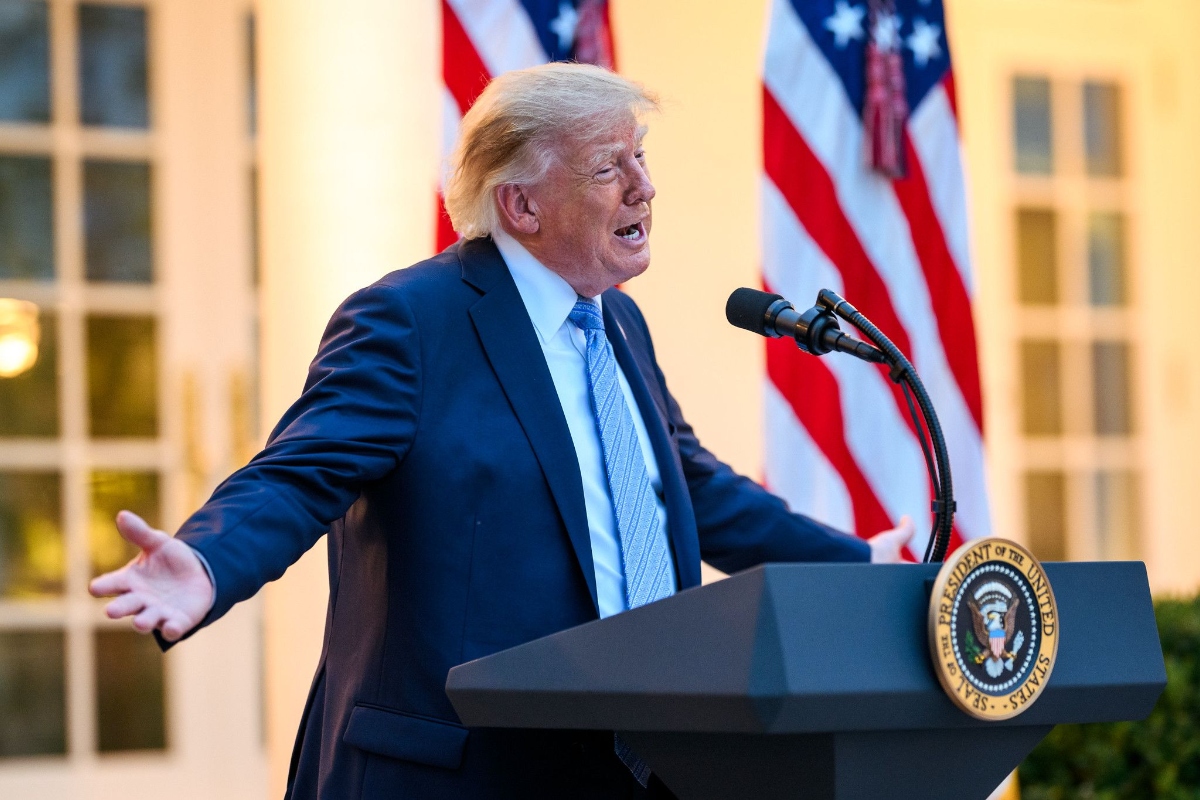
President Donald Trump said the Philippines would buy all of its agricultural products from U.S. producers starting January 1, replacing suppliers including Brazil. (Foto: Instagram)
President Donald Trump said on Friday, November 20, that he had demanded the Philippines buy its agricultural products exclusively from U.S. producers, replacing suppliers including Brazil. He said the change was expected to begin January 1 and linked the demand to U.S. support for the Philippines amid potential conflict with China.
In remarks to reporters, Trump said the Philippines would buy “100%” of its agricultural products from the United States, rather than 90% or 95%. He questioned whether Brazil would help the Philippines in a confrontation with China, adding that the country had previously bought from Brazil and other nations but was now purchasing from the United States.
Before Trump’s news conference, the White House said the U.S. and Philippine governments had agreed to reduce their trade deficit by increasing Philippine purchases of American energy and agricultural products. Trump returned this week from visits to the Philippines and China. His stop in Manila came days after Brazilian President Luiz Inácio Lula da Silva visited the country, met Philippine President Bongbong Marcos and signed an agreement on agricultural and livestock cooperation.
On November 17, the day before Trump met with Marcos, the Philippine government indicated it wanted to maintain and expand agricultural trade with Brazil. The Philippines’ Department of Agriculture described Brazil as one of its leading suppliers of beef, pork and chicken. Figures from Brazil’s Ministry of Industry and Trade show that the Philippines was the 33rd-largest destination for Brazilian exports, with total shipments of $2.36 billion over the past year.
Pork accounted for the largest share of those purchases, at about $841.4 million. Frozen beef exports totaled $422.9 million, while poultry meat and offal exports were valued at $272.6 million, ranking fourth among the listed products. Other Brazilian exports to the Philippines included $415.3 million in iron ore, $147.5 million in corn, $35.7 million in ethanol and $20.3 million in tobacco.
Lula’s effort to find buyers in Asia is part of Brazil’s response to U.S. tariffs. During his visit, he argued for diversifying trade partnerships and said Brazil had decided to seek other partners to sell to and buy from in response to the tariffs.
The United States and Brazil have been engaged in a trade dispute for months. In 2025, Trump raised tariffs on some Brazilian products, citing, among other reasons, Supreme Federal Court rulings against former Brazilian President Jair Bolsonaro, an ally of Trump. In November of that year, Trump backed away from tariffs on food products. In February 2026, the U.S. Supreme Court struck down the tariffs, and Trump responded with a new 10% tariff. In July, the U.S. government imposed additional duties of 25% on certain Brazilian products and 12.5% on others.

