
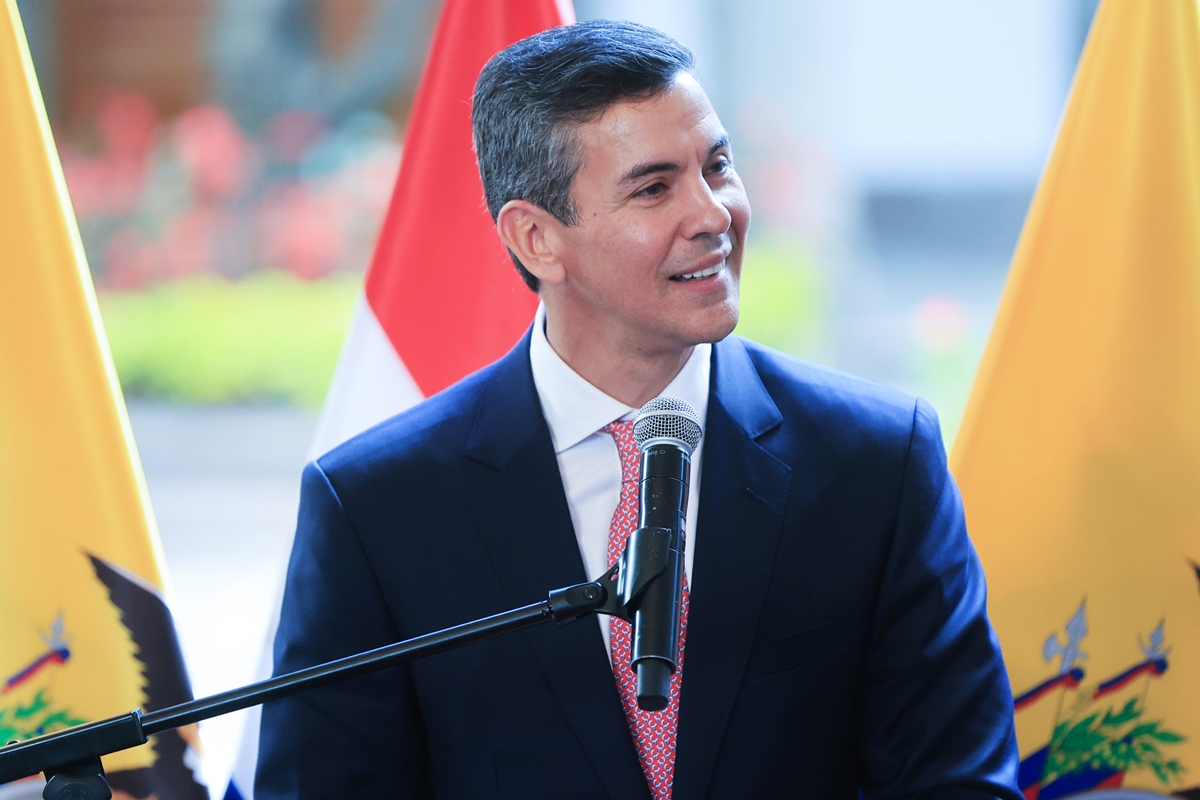
Paraguayan President Santiago Peña announced his resignation on Nov. 5 amid the collapse of Ueno Bank and a political crisis that included impeachment proceedings. (Foto: Instagram)
Paraguayan President Santiago Peña announced his resignation Thursday, Nov. 5, amid the collapse of Ueno Bank, a financial institution with millions of customers and substantial public deposits. The crisis, which also raised questions about ties between the government and the bank’s controlling group, marks a setback for Latin America’s conservative leaders and adds uncertainty to their political alignment with Washington.
The Central Bank of Paraguay intervened in Ueno Bank on Tuesday, Nov. 3, after finding that its solvency ratio was below the 50% minimum required by law. The intervention suspended the bank’s operations, leaving nearly 3 million customers without access to financial services in a country of about 6.1 million people. Ueno Bank held about $850 million in public deposits, including funds belonging to the Social Security Institute.
Investigators have raised suspicions that the bank made irregular loans to companies linked to Grupo Vázquez, which controls Ueno Bank. Peña was a shareholder in the group until March 2025. The scandal escalated politically after he lost support within his own Colorado Party. Former President Horacio Cartes, one of the party’s leading figures, backed efforts to subject Peña to impeachment proceedings.
Although Peña announced his resignation Thursday, the Chamber of Deputies unanimously approved moving forward with impeachment. The Senate called on him to present his defense Friday, Nov. 6. Vice President Pedro Alliana, also a member of the Colorado Party, is expected to take over. The departure comes as other conservative leaders in the region face political or economic challenges. In Argentina, President Javier Milei is experiencing difficulties on both fronts. In Brazil, Flávio Bolsonaro lost the 2026 presidential contest to Luiz Inácio Lula da Silva and fled to the United States, interrupting a pro-Trump wave in Latin America, according to the article.
The leaders do not constitute a uniform ideological bloc, but they share conservative agendas, opposition to the left and political ties to President Donald Trump. Peña represented a more technocratic, liberal current focused on attracting foreign investment, fiscal discipline and reducing state involvement in the economy. Milei, by contrast, is a prominent advocate of ultraliberal economics who came to power criticizing the traditional political establishment and calling for a smaller state. Peña was ideologically close to Milei, who has cited Paraguay as an economic model for the region.
Other leaders represent distinct strands of the right. In El Salvador, Nayib Bukele’s approach centers on tougher public security policies and fighting criminal groups; it has drawn international attention for mass incarceration and the suspension of constitutional guarantees under a state of emergency. In Chile, José Antonio Kast’s conservative platform emphasizes fighting crime, controlling immigration and defending traditional values. In Brazil, Bolsonaro supporters are part of the broader political current through a conservative agenda and strong opposition to the left.
Peña’s exit also removes one of Washington’s key interlocutors in South America. During his government, Paraguay deepened cooperation with the United States on security, defense and intelligence. The country joined the Americas Shield, a Trump administration initiative to combat drug trafficking and criminal organizations, and approved a bilateral agreement setting conditions for the temporary presence of U.S. military personnel and civilian employees in Paraguay. Asunción also aligned with Washington on strategic issues, including countering Chinese influence, while maintaining official relations with Taiwan rather than recognizing Beijing. Alliana is not expected to make immediate changes to these policies, but the political crisis and domestic pressure over the previous government’s decisions could affect whether the agreements continue.

