
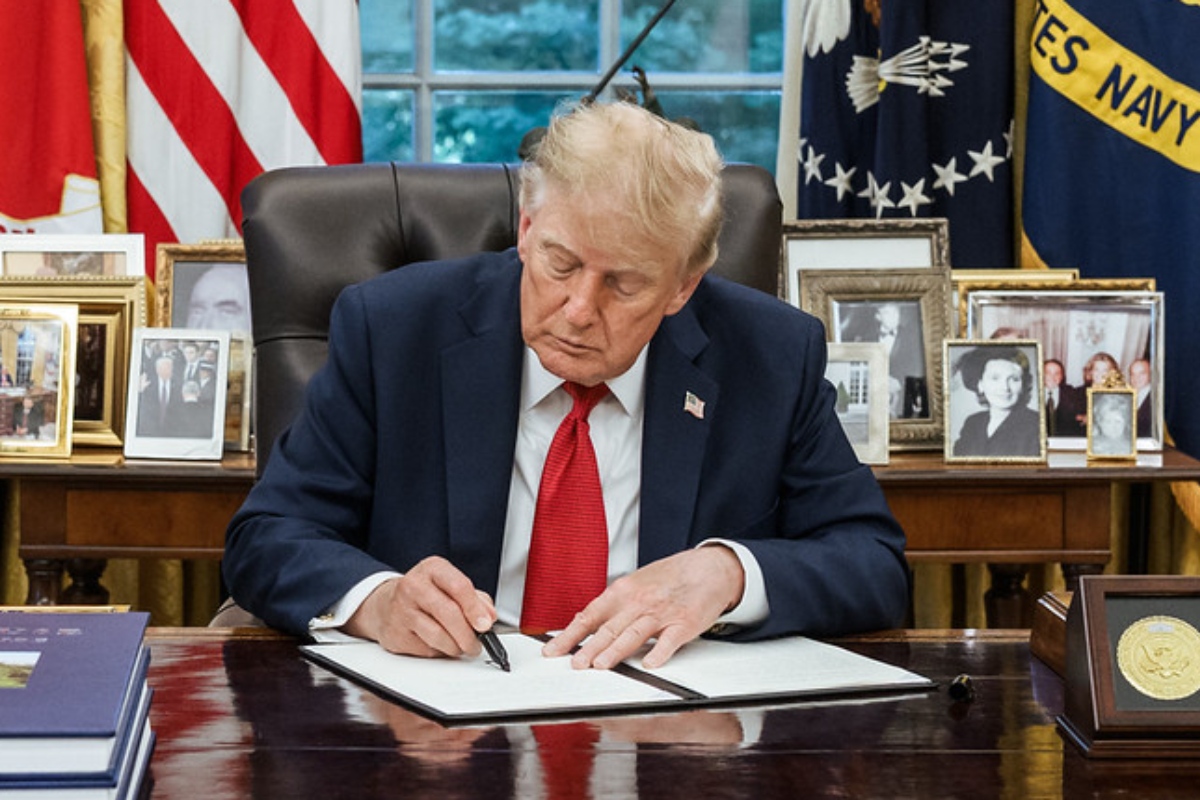
President Donald Trump signed a proclamation reaffirming U.S. ambitions to lead space exploration and establish a lasting presence beyond Earth. (Foto: Instagram)
President Donald Trump signed a proclamation on Tuesday, Nov. 3, declaring the solar system and space beyond Earth to be a domain of all humanity. The document also restates the U.S. government’s intention to lead space exploration and establish a permanent presence beyond the planet.
The proclamation says U.S. citizens may explore, develop and use space, including by establishing settlements, as long as those activities comply with U.S. law and the country’s international commitments. It describes the solar system and space beyond Earth as open to exploration and development, and to the establishment of a permanent presence by Americans.
Trump also said the United States should lead human expansion beyond Earth. According to the proclamation, the country intends to build facilities, develop resources and maintain a lasting presence in space, with the aims of expanding U.S. exploration and strengthening national security. “My administration reaffirms that our solar system and all space beyond Earth are a domain of all humanity, and that our nation will lead the exploration, development, use and settlement of these new frontiers,” he said.
The proclamation comes as the United States and China plan to resume crewed missions to the Moon. The United States aims to land astronauts there by 2028, while China is working to send astronauts to the lunar surface by 2030. Both countries also plan to expand the length of time people remain on the Moon.
The principle that space should be a domain of all humanity predates Trump’s proclamation. It is included in the Outer Space Treaty, an international agreement signed in 1967 during the Cold War and the space race between the United States and the Soviet Union. The United States, the Soviet Union and the United Kingdom were the treaty’s initial signatories, and it took effect in October of that year. After the Soviet Union dissolved in 1991, Russia assumed its place as the treaty’s successor state.
The treaty was intended to establish rules for countries’ activities beyond Earth as technological advances opened new possibilities for exploration. It states that space should be used for peaceful purposes and sought to prevent competition among major powers from turning into territorial disputes over the Moon and other celestial bodies. Under the agreement, no country may claim sovereignty over or otherwise appropriate space, the Moon or other celestial bodies, including through occupation. The treaty also says space exploration should benefit all countries, regardless of their level of development, and guarantees freedom of access and scientific investigation. It prohibits placing nuclear or other weapons of mass destruction in orbit or on celestial bodies, limits the use of the Moon and other planets to peaceful activities, and makes countries responsible for space activities carried out by their governments as well as private companies and organizations.

