
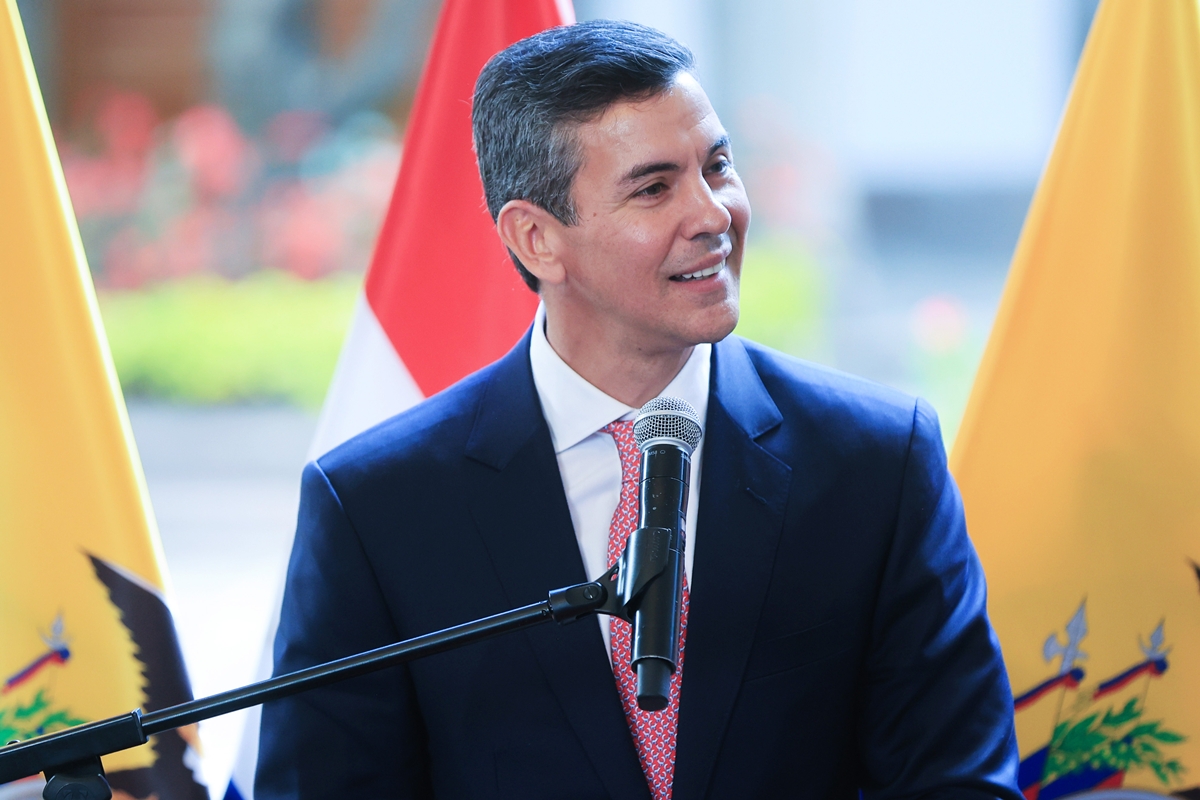
Santiago Peña resigned as Paraguay’s president on Nov. 5. He was affiliated with the conservative Colorado Party and took office in August 2023. (Foto: Instagram)
Santiago Peña, who resigned as Paraguay’s president on Nov. 5, is affiliated with the country’s right-wing Colorado Party and describes himself as socially conservative and economically liberal. The party, formally known as the National Republican Association (Asociación Nacional Republicana, or ANR), is one of Paraguay’s major political forces and among South America’s longest-established parties. Its ideology includes social conservatism, economic liberalism and Paraguayan nationalism.
The Colorado Party has been a central force in Paraguayan politics for decades and is historically associated with conservative and nationalist positions. Peña is part of the party’s Cartes-aligned faction, linked to former President Horacio Cartes, who backed Peña’s candidacy. Peña won the presidency in April 2023, defeating opposition candidate Efraín Alegre. He succeeded Mario Abdo Benítez, also a Colorado Party member, and took office in August 2023.
On economic policy, Peña has advocated keeping taxes low and maintaining conditions favorable to businesses. He has presented Paraguay as a country with potential to attract investment and expand its role in international trade. At the same time, he has said the private sector should operate alongside government involvement in areas such as health care, education and public safety. His economic views place him on the right, though he has argued for balancing market activity with a state role.
Peña also holds conservative social positions, particularly on family issues. He has opposed legalizing abortion and same-sex marriage. In 2024, he said Paraguayan society is conservative and that the country’s Constitution defines the union of a man and a woman as the basis of family. In a 2023 interview with Argentina’s Clarín newspaper, he acknowledged that his profile could be seen as closer to the right, but said his political approach should not be reduced to a left-right divide. He described his priority as Paraguay’s development and a balance between the state and the market economy.
Peña studied economics at Universidad Católica Nuestra Señora de la Asunción in Paraguay and began his professional career at the Central Bank of Paraguay. He later completed postgraduate studies at Columbia University in the United States and worked at the International Monetary Fund in a department focused on African affairs. After returning to Paraguay, he rejoined the central bank. In 2015, he became finance minister under Cartes and remained in the post until 2017; during that period, he joined the Colorado Party. He lost to Abdo Benítez in the party’s 2018 internal election before returning to the presidential race five years later and defeating Alegre.
Peña’s resignation came after a crisis involving Ueno Bank. On Nov. 3, Paraguay’s central bank ordered the institution to suspend operations and began a resolution process, saying the bank was unable to meet its financial obligations. Peña’s ties to the bank’s controlling group prompted opposition lawmakers to file a request for political trial. The crisis also led to departures at the central bank: its president, Carlos Carvallo, and two other members of its board resigned.

