
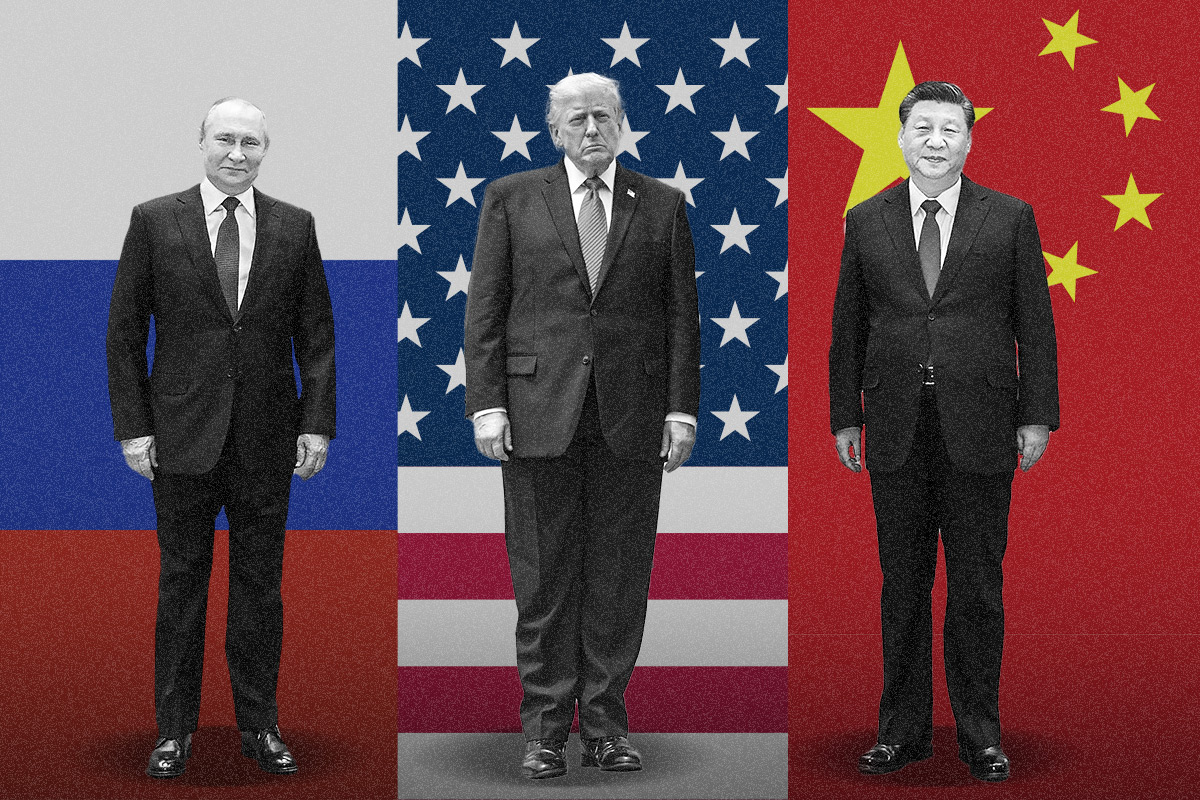
President Donald Trump began a trip to the Philippines and China on Nov. 16, with a planned meeting with Chinese President Xi Jinping and Russian President Vladimir Putin scheduled for Nov. 19. (Foto: Instagram)
President Donald Trump began an international trip on Nov. 16, traveling to the Philippines and China. The trip’s central event is a planned meeting with Chinese President Xi Jinping and Russian President Vladimir Putin—the first joint gathering of the leaders of the three global powers, according to the report. The meeting is scheduled for Nov. 19 in China.
Trump’s first stop is the Philippines, where he is attending the 49th summit of the Association of Southeast Asian Nations (ASEAN) and making a state visit alongside Philippine President Ferdinand Marcos Jr. The summit is taking place amid international trade tensions linked to Trump’s tariff policies and the war in Iran. The ASEAN leaders’ summit opened Nov. 15 and included new trade agreements between member countries and invited nations.
After his visit to the Philippines, Trump is due to travel to Shenzhen, China, for the Asia-Pacific Economic Cooperation forum. On the sidelines of that event, he is expected to meet with Putin and Xi in a trilateral discussion. The leaders are expected to address the war between Russia and Ukraine, the conflict involving Iran in the Middle East, and competition between the United States and China over technology, including artificial intelligence and chip production. The countries have said that “world peace” will be among the conversation’s central themes.
Analysts cited in the report do not expect the meeting to produce major announcements or agreements, but say it could still affect the geopolitical landscape, particularly regarding conflicts involving Russia and the United States. Vitelio Brustolin, an international relations professor at Fluminense Federal University and a Harvard researcher, said the meeting has prompted concern that it could become a “new Yalta Conference.” Held in 1945 after World War II, the Yalta meeting brought together leaders of the United States, the Soviet Union and the United Kingdom to discuss the postwar order.
Brustolin said Yalta has been increasingly invoked in European capitals because it represents a moment when major powers determined the fate of countries that were not at the negotiating table. He cautioned, however, that the circumstances differ: unlike in 1945, there is no shared adversary like Nazi Germany to unite the three powers. He also criticized Trump’s approach, saying it disregards international law and the post-World War II order, and that Trump’s 2025 national security strategy treats the Western Hemisphere as an area of U.S. dominance.
European nations, especially Ukraine, are watching the meeting with concern. Ukraine has been at war with Russia for nearly five years, with no clear prospect of a resolution, and some fear that agreements could be reached without the involvement of countries directly affected. China is described as a longstanding ally of Moscow, while U.S. signals about the war in Eastern Europe have been mixed. That combination has raised fears that Ukraine’s future could be discussed without Ukrainian participation, as happened to Germany after World War II. Beijing and Moscow are also concerned about the Iran war, which was started by the United States and Israel, according to the report. Rising oil prices have affected international trade, including commerce involving China and Russia, as well as the course of the war in Ukraine.
Brazilian President Luiz Inácio Lula da Silva also took part in the ASEAN summit. With U.S. tariffs raising the cost of exports to the United States, Asian countries have expanded their role in international trade. Lula highlighted growing Brazilian trade with Asian countries despite U.S. tariffs on Brazil. He said his government had sought other trading partners rather than asking Washington for relief. Lula added that while trade between Brazil and the United States had declined, trade with Indonesia rose 15% and with Vietnam increased 13%.

